Showing posts with label Tashima. Show all posts

Saturday, December 13, 2014

At the Newland House Museum: It was a 1914 Holiday for Historic Wintersburg and the Huntington Beach Historical Society

IT'S 1914: Historic Wintersburg Task Force member Dennis Masuda gets fully into character in the Tashima Market display on the front lawn of the Newland House Museum for Holidays in Huntington Beach, 1914.  Both Historic Wintersburg Task Force members and Huntington Beach Historical Society members provided "pioneers" for visitors to meet.  (Photo by Mary Urashima, December 5, 2014) © All rights reserved.

OUR NEW ASSEMBLYMAN:  Matthew Harper, now Assemblyman of the 74th District and immediate past mayor of Huntington Beach (center), inside the Tashima market with Historic Wintersburg Task Force members Dennis Masuda and Rebecca Nehez.  Assemblyman Harper helped present The Order of the Newland Rose to Historic Wintersburg Task Force chair, Mary Urashima, "for her continued work in historic preservation in Huntington Beach, namely the Wintersburg Historic District. We honor her for her efforts to our treasured buildings as well as the diverse history of our community." (Photo courtesy of Gregory Robertson, Dec. 5 2014) © All rights reserved.

ORANGE COUNTY PIONEERS: The Tashima family with Historic Wintersburg Task Force members Kanji Sahara (third from left) and Rebecca Nehez (far right), with Task Force chair and Historic Wintersburg author Mary Urashima (third from left).  The Tashima's traveled from outside Orange County to be at the event. (Photo courtesy of Gregory Robertson, Dec. 5 2014) © All rights reserved.

NIGHT FALL: A crowd began to arrive as holiday candles glimmered in the windows of the Newland House.  Approximately 200 to 250 people attended the open house Holidays in Huntington Beach, 1914 event. (Photo courtesy of Gregory Robertson, Dec. 5 2014) © All rights reserved.

WHERE IS WINTERSBURG? A directional sign at the event provided the mileage from the Newland House to locations significant to the Japanese pioneer community, as well as for Huntington Beach's Sister City in Anjo, Japan.  The sign was crafted by Historic Wintersburg Task Force member Barbara Haynes.

Mileage from the Newland House:  Wintersburg Village, 2.7 miles (Wintersburg Mission, Furuta farm, Tashima market); Smeltzer, 3.9 miles (Southern Pacific Railroad siding, Chino camp); Garden Grove, 12.2 miles (Ida Tofu Factory, Japanese Language School); Talbert, 3.3 miles (Escalante Circus campsite, Ishii home, Kato farm, Japanese Language School); Santa Ana, 11.7 miles (Santa Ana early 1900s produce market); Costa Mesa, 6.8 miles (Japanese Language School); Laguna Beach, 14.3 miles (Japanese Language School); Little Tokyo, 36.2 miles (Fugetsu-do confectionery); Anjo, Japan, 5651 miles (Huntington Beach Sister City). (Photo by Mary Urashima, December 5, 2014) © All rights reserved.

TASHIMA MARKET DETAILS: A pair of handwoven tatami sandals and bamboo rake in the Tashima market were among the details providing a glimpse back to 1914.   

These items can be found today in the Historic District of Little Tokyo, Los Angeles, at Anzen Hardware on First Street, which is worth a field trip in itself.  Early 1900s residents of Wintersburg and Smeltzer's Japanese community traveled back and forth to Little Tokyo regularly, on the Pacific Electric Railway "Red Car."  Yukiko Furuta's 1982 oral history includes a reference to shopping in Little Tokyo and enjoying the sweets at a confectionery that undoubtedly was Fugetsu-do Sweet Shop, which opened in 1903.

Also in the market were major crops for Wintersburg and Smeltzer, celery and chili peppers, advertisements from the Orange County Directory for 1913, and a 1914 recipe book.  (Photo by Mary Urashima, December 5, 2014) © All rights reserved.


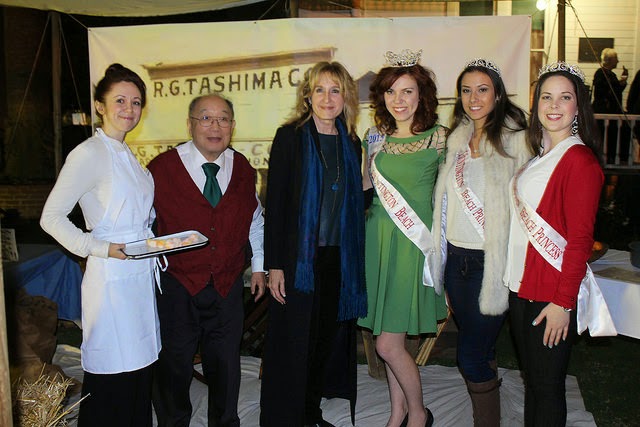
LOCAL ROYALTY: Miss Huntington Beach, Claire Epting (center, in green), and her court, Alexis Rodriguez and Jena Jean Farris, in the Tashima market with Historic Wintersburg Task Force members Rebecca Nehez (far left), Kanji Sahara (second from left) and Mary Urashima (center). (Photo courtesy of Gregory Robertson, Dec. 5 2014) © All rights reserved.

A SENSE OF COMMUNITY: Local businessman Ed Laird (left) with his family, chats with Assemblyman Matthew Harper (center), Chris McDonald of the Local News (in straw hat) and Huntington Beach Historical Society president Darrell Rivers (in 1914 attire with top hat). (Photo courtesy of Gregory Robertson, Dec. 5 2014) © All rights reserved.

PASSING ON HISTORY: Inside the Tashima market, Kanji Sahara enthralls a visitor as he shares the history of Japanese pioneers and the significance of Historic Wintersburg. In addition to volunteering his time for Historic Wintersburg, Sahara is on the Japanese American Citizens League board and a member of the Tuna Canyon Detention Station Coalition Board. (Photo courtesy of Gregory Robertson, Dec. 5 2014) © All rights reserved.

WINDOW INTO THE PAST: Near the Tashima market display, an exhibit constructed of vintage windows shares historical photographs and information about Historic Wintersburg.  This display made of re-purposed materials---in keeping with the purpose of preservation to re-use and recycle---was used at the Smithsonian Museum's traveling exhibit, Journey Stories, at the Heritage Museum of Orange County in October 2014. (Photo courtesy of Gregory Robertson, Dec. 5 2014) © All rights reserved.

FRIENDS OF HISTORIC WINTERSBURG: Leadership from the Japanese American Citizens League (JACL) Pacific Southwest joined Historic Wintersburg Task Force member Kanji Sahara in the Tashima market. (Photo courtesy of Gregory Robertson, Dec. 5, 2014) © All rights reserved.

The JACL recognized Task Force chair Mary Urashima with their Community Hero award this year at the Skirball Center in Los Angeles, and has actively supported the preservation of Historic Wintersburg.  

The Japanese American Citizens League was formed in 1929 in California and Washington, and spread to become the largest and most well-known Japanese American organization in the United States.  JACL was instrumental in the passage of the Civil Rights Act of 1988, signed by President Ronald Reagan.  

Today, it is the U.S.'s oldest and largest Asian American civil rights organization, with 108 chapters nationwide. JACL continues to work on existing and emerging civil liberties issues. 

MOCHI! Special thanks to one of our event sponsors, Fugetsu-do Sweet Shop, on First Street in Little Tokyo, Los Angeles.  Guests at the event had the opportunity to taste mochi, a sweet rice confection, at the Tashima market, offered on a vintage tray by a pioneer. Information and directions to Fugetsu-do at http://www.fugetsu-do.com/   (Photo courtesy of Gregory Robertson, Dec. 5 2014) © All rights reserved.

More event photographs and information about the preservation effort for Historic Wintersburg can be found on our Facebook page, https://www.facebook.com/pages/Historic-Wintersburg-Preservation-Task-Force/433990979985360


HAPPY HOLIDAYS! Santa (the jolly fellow at right) greeted visitors from 1914 and 2014 inside the Newland House, checking his list.  We wish all our readers a very happy holiday season and joyous New Year in 2015. (Photo courtesy of Gregory Robertson, Dec. 5, 2014)
© All rights reserved.

Thank you to our hosts at Holidays in Huntington Beach, 1914, the Huntington Beach Historical Society. 

We are endlessly appreciative of our Historic Wintersburg Task Force members and volunteers.  You made this happen! 

Thank you to Assemblyman Matthew Harper, Huntington Beach Mayor Jill Hardy, and the other dignitaries, officials, and all our guests who stopped by to celebrate the Holidays in Huntington Beach, 1914.  Sharing history is sharing community.

Historic Wintersburg will have much more news to share in 2015 about the effort to preserve one of America's 11 Most Endangered Historic Places.  We appreciate the growing support, both locally and nationally, to save Historic Wintersburg for future generations.  

Perhaps in 2114, there will be holiday events looking back 200 years, at both the Newland House and at Historic Wintersburg.  The world will be a different place in the next century.  Knowing where we come from and how far we all have traveled will be even more important.

© All rights reserved.  No part of the Historic Wintersburg blog may be reproduced or duplicated without prior written permission from the author and publisher, M. Adams Urashima

Sunday, November 23, 2014

EVENT: Holidays in Huntington Beach, 1914

The Tashima Market in Wintersburg Village was a feed and seed store, as well as a general market for groceries for the pioneer community.  The Tashima Market and the McIntosh Meat Co. market were the two main food markets for the rural farming community.  (Photograph courtesy of Eugene Tashima) © All rights reserved.

   The Huntington Beach Historical Society is hosting their annual holiday open house with a new partner this year, Historic Wintersburg in Huntington Beach.  The event, Holidays in Huntington Beach, will be held at the Newland House Museum, with historical displays of life a century ago.
 
   The Newland House is listed on the National Register of Historic Places, and dates to 1898 when it was built for William and Mary Newland, pioneer settlers of Huntington Beach.  The Newland House was saved and preserved through a community effort.  It is now one of the oldest homes remaining in Huntington Beach, a reminder of Orange County’s pioneer community.  The Newland House and gardens will be open, free to the general public during the event.

   Holidays in Huntington Beach also will feature a glimpse of Historic Wintersburg in Huntington Beach, named in June 2014 one of America’s 11 Most Endangered Historic Places by the National Trust for Historic Preservation.  

   Wintersburg Village began forming in the 1880s and was annexed into the City of Huntington Beach in 1957.  Charles Furuta, owner of the Furuta farm at Historic Wintersburg arrived in what would become Huntington Beach approximately five to six years after the Newland House was built.

   Event guests will walk into Wintersburg Village’s Tashima Market on the front lawn of the Newland House and view a display of historical photographs relating to Huntington Beach’s Japanese pioneers.  There will be opportunity to chat with pioneers, as part of the exhibit re-enactment.  Also, guests can try a taste of mochi, a traditional rice flour sweet, courtesy of the century-old Fugetsu-do Sweet Shop, a confectionery in Little Tokyo.

Left: The Fugetsu-do Sweet Shop in Little Tokyo, Los Angeles, dates back to 1903.  Wintersburg Village residents traveled to Little Tokyo for shopping via the Pacific Electric Railway, also known as the "Red Car," in the early 1900s. (Photograph, M. Urashima, November 22, 2014)  © All rights reserved.

   Some items will be available at the "Christmas market" as donation opportunities for the preservation work.  Historic Wintersburg in Huntington Beach author, Mary Adams Urashima, will have copies of her books available for sale and signing.  

   The event features live holiday music and refreshments.  As part of the holiday tradition, Santa will make an appearance at the Newland House, making this an event for all ages!

Right: The stately Newland House, circa 1910, with "Bob, the dog" out front. (Photograph courtesy of City of Huntington Beach archives)

   Holidays in Huntington Beach is at the Newland House Museum, Friday, December 5, from 5:30 p.m. to 9 p.m., 19820 Beach Boulevard (in the Newland Shopping Center at Beach Boulevard and Adams Avenue).  

   Admission is free.  Guests are encouraged to arrive in 1914 fashion and be of good cheer!

Left: The traditional holiday and special event sweet, mochi.  Mochi is a rice cake made usually at the New Year holiday in a ceremony called mochitsuki.  Fugetsu-do Sweet Shop is sending its famous "Rainbow Dango" mochi. (Photograph, WikiCommons)

More information about the Newland House Museum and the Huntington Beach Historical Society can be found at   https://www.facebook.com/HBHistoricalSociety

More information about Historic Wintersburg can be found on this blog and on our Facebook page at https://www.facebook.com/pages/Historic-Wintersburg-Preservation-Task-Force/433990979985360
 

© All rights reserved.  No part of the Historic Wintersburg blog may be reproduced or duplicated without prior written permission from the author and publisher, M. Adams Urashima

Friday, April 25, 2014

April 1942

The south side with enclosed sun porch of the Furuta bungalow at Historic Wintersburg.  In February 1942, the F.B.I. came for Charles Mitsuji Furuta while he was working on the goldfish farm.  They investigated his closet and office in the sun porch, then took him to the Tuna Canyon Detention Station in Los Angeles County.  (Photo, April 18, 2014)

   In late April 1942, Yukiko Furuta and her children had officially been warned they would have to evacuate California by mid May.  They had been given notice around April 14 to 16, and had begun to pack.

    Charles Mitusji Furuta had already been taken to the Tuna Canyon Detention Station (Tajunga, Los Angeles County). Yukiko was faced with how to pack and store four decades of life in America. Those being evacuated had been told they could bring only one suitcase.


   The Furutas would store belongings at the home of brother-in-law Henry Kiyomi Akiyama, at the Pacific Goldfish Farm located then at Goldenwest and Bolsa streets in nearby Westminster. Akiyama's Caucasian employees would watch over the property and manage the farm during his absence.  Another family would watch over the Furuta Gold Fish Farm in Wintersburg Village.

Right: The Pacific Goldfish Farm, at Goldenwest Street and Bolsa Avenue, located where the Westminster Mall is today, circa 1940s.  The farm contained 40 acres of goldfish farms.  It is estimated there were 100,000 to 200,000 fish by the time World War II started. (Photo courtesy of the Akiyama family and California State University Fullerton, Center for Oral and Public History, PJA Akiyama 1751) © All rights reserved.

   Yukiko described the time before evacuation in her 1982 interview with Professor Emeritus Arthur Hansen for the Honorable Stephen K. Tamura Orange County Japanese American Oral History Project. The interview was conducted with the help of an interpreter, Yasko Gamo.

--------------------------------------------------------------
Yukiko Furuta:
    The F.B.I. came to the church (the Wintersburg Japanese Presbyterian Church) to take Reverend (Sohei Kowta), but then (Kowta) said that all the husbands had been taken and the wives were having trouble. If he would be taken, no one would take care of them. So the F.B.I. agent called the office and talked to the people at the office. Then they decided not to take him. So he could stay in the Japanese community.


Left: Reverend Sohei Kowta* and his wife, Riyo, lived in the manse with their three children--Tadashi, Hiroko and Makoto--at the Wintersburg Japanese Presbyterian Church from 1938 until the time of evacuation in 1942.  He is credited in a U.S. government report with helping unify the religious groups at the Colorado River Relocation Center at Poston, Arizona.  Reverend Kowta also helped organize the Evergreen Hostel in Los Angeles for displaced Japanese Americans returning to Southern California in 1945. (Photo courtesy of Wintersburg Presbyterian Church) © All rights reserved.

    They just stayed home with fear. They could not go out more than five miles from their homes. So they stayed home quietly.

    In the evening they pulled the blind and shade and turned out the light and went to bed early. Her son (Raymond Furuta, a graduate of Huntington Beach High School) was engaged then (to Martha), so he told her that they were going to marry quickly because otherwise they might not be able to get married.

Arthur Hansen:
    When her husband left, did somebody come to the door to pick him up?

Yukiko Furuta:
    Yes. Three big men.

Arthur Hansen:
    Tell me about that. Did you know they were coming or not, then?

Yukiko Furuta:
    They just came and knocked on the door, and when she opened the door there were three big men. They asked whether Mr. Furuta was there? Since he was working at the fish farm outside, she called him.


Right: A portion of a mural that once graced the Huntington Beach Art Center parking area, memorialized the Furuta family history.  At the center, Raymond and Martha Furuta surrounded by goldfish. To their right, an image from a 1923 photograph of Charles and Yukiko Furuta with their children, the 1934 Wintersburg Japanese Presbyterian Church behind them.  In the upper right corner, flanked by the lily flowers sold by the Furutas, the barracks of the Colorado River Relocation Center at Poston, Arizona. (Photo courtesy of the Furuta family) © All rights reserved.

Arthur Hansen:

    It was during the day?

Yukiko Furuta:
    Yes. So the F.B.I. men said they had come for Mr. Furuta.

    For a while after Pearl Harbor, they were told they couldn't own guns or cameras or even flashlights. So they had to take them to the (Huntington Beach) city hall. So they already didn't have those things.


Left: The Huntington Beach city hall, as it appeared circa 1940s, was located near the present-day Main Street Library and Triangle Park off Main Street.  The civilian defense program established by Huntington Beach city officials during the war instituted a coastal watch, for which some of the volunteers scouted the coastline from the rooftop of the city hall and next door Memorial Hall. (Photo, City of Huntington Beach archives)

   ...the F.B.I. agents came into the house and examined Mr. Furuta's desk and closet. They couldn't find anything in there. 

Arthur Hansen:
...Which room was that? (the room which is now the sun porch in the rear of the interviewee's house)

Yukiko Furuta:
    Since he had already packed his suitcase, he went then with the F.B.I. men.

Arthur Hansen: 

   That same day he went?

Yukiko Furuta: 

   The agents waited while Mr. Furuta changed his clothing. And then they examined his baggage.

Arthur Hansen:

  What kind of instructions did (Charles Furuta) give the family?

Left: Images of the senior class from Raymond Furuta's 1932 Huntington Beach High School yearbook, the Cauldron, his photo at center left on the right-side page. (Photo, October 2013) © All rights reserved.

Yukiko Furuta:
    They might have talked to the children. But the children said, later on, that the F.B.I. men had made a joke to them. But they didn't give any particular instruction to her.

    (Charles) said to (Yukiko) that in the long run their property might be confiscated because they were all enemy aliens; so the most important thing was that everybody was alive and well. And he didn't have much time to talk any further.

    So later on they corresponded with each other. And one of the things she mentioned was written in one of his letters--that the family should evacuate with other Japanese.


   (Charles) forgot to take something with him when he left, so (Yukiko) told her daughter (Toshiko) to find out where he was. So (Toshiko) asked them to find out if he was in the Huntington Beach jail...she took something he had forgotten to the Huntington Beach jail. 

   And after staying there for one day...he was taken to Tujunga (the Tuna Canyon Detention Station), and she visited him at Tujunga two times. (Yukiko) had to go to Santa Ana and get permission to visit him...she could only talk for ten minutes to her husband through the fence.


The Tuna Canyon Detention Station, circa 1933, was a former Civilian Conservation Corps camp used as a temporary detention facility.  Along with Charles Furuta, Gunjiro Tashima--owner of the Tashima Market across the street from the Mission in Wintersburg, and later, to Beach and Garden Grove Boulevard--was taken to Tuna Canyon.  Masayuki and Takayuki attended Huntington Beach High School. (Photo courtesy of the Densho Encyclopedia) 

Seventy-two years later, with Etsuko Furuta
   In a 2013 oral history interview conducted by Professor Emeritus Arthur Hansen on behalf of Historic Wintersburg with Etsuko Furuta Fukushima---Charles and Yukiko's daughter, now 93 and living in northern California---Tuna Canyon and the fence that separated their family is a vivid memory.  

Etsuko Furuta Fukushima:
I remember the fence, the wire fence. And I don't remember we were able to talk to him through the fence...I don't think we were able to get inside.

Arthur Hansen:
How do you feel about the whole thing of seeing your father on the other side of the fence?

Etsuko Furuta Fukushima:
I thought, "For heaven's sake, he couldn't be a spy," but then the F.B.I. were wrong.

----------------------------------------------------
   
   By May 1942, the entire Japanese community, the Issei and American-born Nisei, were forcibly evacuated from Orange County and confined at what would be called detention or relocation centers in other states.  

   Everyone associated with the California pioneer property known today as Historic Wintersburg--the Furuta family of the Furuta Gold Fish Farm and the Wintersburg Japanese Presbyterian Mission's clergy and entire congregation--were removed from California.  

   Most were confined at the Colorado River Relocation Center at Poston, Arizona, and some at Gila River Relocation Center, also in Arizona.  Some families were separated, the men being taken to military or immigration detention centers in other states.  Charles Furuta would be separated from his family for a year, most of the time spent at the military detention center in Lordsburg, New Mexico.

   For the next three years, the families of Historic Wintersburg would endure what would later be acknowledged through Congressional investigations as one of the largest civil liberties tragedies in American history.  

   Forty-six years after Executive Order 9066, President Ronald Reagan would sign the Civil Liberties Act of 1988 providing reparations to Japanese Americans.  During the signing ceremony, President Reagan would specifically talk about a Wintersburg Japanese Presbyterian Mission family, the Masuda family.  At the signing with President Reagan in Washington, D.C., another Wintersburg Japanese Presbyterian Mission congregant who had lobbied for the Act, Clarence Nishizu.
 ------------------------------------------------------

Read about the Reverend Sohei Kowta and his family, http://historicwintersburg.blogspot.com/2013/02/reverend-sohei-kowta-sunday-before.html

Read about the Tashima family, http://historicwintersburg.blogspot.com/2012/07/the-tashimas-of-wintersburg.html

Read about the Masuda family, http://historicwintersburg.blogspot.com/2012/06/masudas-national-civil-liberties-icons.html   

© All rights reserved.  No part of the Historic Wintersburg blog may be reproduced or duplicated without prior written permission from the author and publisher, M. Adams Urashima.