Showing posts with label Urban Land Institute. Show all posts

Thursday, July 23, 2015

Years in the making: A chance for preservation

ABOVE: Blue sky through the Furuta barn at Historic Wintersburg. This barn is the last pioneer heritage barn left in Huntington Beach, most likely constructed between 1908 and 1912. (Photo, M. Urashima, 2013) © All rights reserved.

   This week, the Huntington Beach City Council took action to comply with the Orange County Superior Court order to reverse the zoning action taken in November 2013.  This returns the zoning from industrial / commercial to its prior zoning of residential.

   "Following a court order issued in June, the Huntington Beach City Council voted Monday night to rezone the Historic Wintersburg site to its original designation," reports the Huntington Beach Independent. "Republic Services, which bought Rainbow in October, said it had no plans to demolish the site and would allow preservationists to continue studying ways of preserving the structures." 

   Read the full article from the Huntington Beach Independent at http://www.hbindependent.com/news/tn-hbi-me-0723-wintersburg-20150722,0,805940.story  
 
    The Orange County Register also covered this development at http://www.ocregister.com/articles/site-672934-land-plan.html

   We have clarifications for the Orange County Register online article: The Wintersburg Mission was founded in 1904 and the Historic Wintersburg property was purchased in 1908 (the Mission congregants met in a Wintersburg barn until they had a building). There are six structures: 1910 Mission, 1910 manse (parsonage), 1934 Church, 1912 Furuta bungalow, 1947 Furuta post-WWII ranch house, and the last pioneer barn in Huntington Beach, probably constructed between 1908 and 1912.

RIGHT: Historic Wintersburg contains thousands of stories, some known, some yet to be uncovered. Along with preservation, we continue to research and write about Orange County's pioneer Japanese American community. A second book is in the future! (Image: A collage of historical photographs representing the history of the Furuta family, Wintersburg Mission and Wintersburg Village. Sources include the Furuta family and Wintersburg Church.) © All rights reserved.

   Also, we have a clarification to this statement in the Orange County Register online article: "The panel is considering several options for the site, including moving the buildings to another location, opening a restaurant or retail center that preserves the history of the site (like The Packing House, a food mall made inside a former fruit-packing plant in Anaheim) or building an educational center."  

   Our clarification: The preservation options are on the property (not moving buildings off site), we are not considering a retail center or restaurants (the Packing District are good examples of adaptive reuse, but not what is being proposed).  While the property reverts to the residential zoning which occurred after the City of Huntington Beach annexed Wintersburg Village in 1957, no residential housing is planned for the property per the property owner.

ABOVE: California Preservation Foundation members contemplate the significant history represented by Historic Wintersburg, during their tour in May 2013.  The property has been inspected by other interested organizations and officials, including the National Park Service, National Trust for Historic Preservation, and the Consulate General of Japan in Los Angeles.  An upcoming tour will be provided to a delegation from Huntington Beach's Sister City of Anjo, Japan. (Photo courtesy of Chris Jepsen) © All rights reserved.

   The proposals for preservation and adaptive reuse included in the final report from the Urban Land Institute have not yet been released (expected in September / October 2015).  This report (see our June 10, 2015, post on this blog) will provide details on the options that can work for the property owner, preservation effort and community stakeholders, and provides the vision for a collaborative path forward.   The official publication of the Urban Land Institute report will be announced here, along with our partners at the National Trust for Historic Preservation.  

   With the release of the report, there will be a call to action, to support the next phase of our effort to preserve Historic Wintersburg for future generations.  Help our preservation effort and one day, walk the land that tells the story of Japanese American pioneer settlement of the American West.

JOIN THE PRESERVATION TEAM ON FACEBOOK: https://www.facebook.com/pages/Historic-Wintersburg-Preservation-Task-Force/433990979985360

FOLLOW US ON INSTAGRAM: @historic_wintersburg 

DONATE: Information on our City of Huntington Beach web page (*We will be transitioning into a California non profit, but also continue as a City task force at this time). http://www.huntingtonbeachca.gov/i_want_to/give/donation-wintersburg.cfm

All rights reserved.  No part of the Historic Wintersburg blog may be reproduced or duplicated without prior written permission from the author and publisher, M. Adams Urashima. 

Wednesday, June 10, 2015

Urban Land Institute conducts Technical Assistance Panel at Historic Wintersburg

 
   Last week, the Historic Wintersburg Preservation Task Force was joined by the National Trust for Historic Preservation and the Urban Land Institute (ULI) for a Technical Assistance Panel (TAP) which will result in findings and recommendations regarding alternatives for the property's historic preservation.   

LEFT: The Urban Land Institute team at Historic Wintersburg, preparing for their inspection of the property. A dozen ULI panelists and ULI staff spent several weeks doing advance research and dedicated two days to working on the TAP in Huntington Beach.(Photo, M. Urashima, June 3, 2015) © All rights reserved.

   The ULI is a 501(c) (3) nonprofit research and education organization supported by its members.  Founded in 1936, ULI has more than 33,000 members worldwide, representing the entire spectrum of land use and real estate development disciplines working in private enterprise and public service.  

   Through the TAP process, ULI facilitates an open exchange of ideas, information, and experience to arrive at informed findings and recommendations for challenging land use issues.  The ULI strives to achieve a balanced approach through the selection of panelists and through the stakeholder interviews, engaging community members with differing opinions, backgrounds and expertise.

   The TAP process was facilitated for the Historic Wintersburg Preservation Task Force by the National Trust for Historic Preservation (Trust), after a major fundraising effort in 2014.  The Trust and ULI have conducted similar efforts for historic properties with challenging issues and diverse stakeholders, such as the Houston Astrodome (read more at http://www.savingplaces.org/updates/urban-land-institutes-bold-report-declares-astrodome-can-and-should-live#.VXjCp0ZLUg4).

RIGHT: A ULI panelist talks about the century-old pines at Historic Wintersburg, with pioneer descendent Norman Furuta, whose grandfather planted the trees on the property.  Historic Wintersburg extends its appreciation to the Furuta family for continuing to be a resource for historical information. (Photo, M. Urashima, June 3, 2015) © All rights reserved.

   In 2012, the Trust and ULI announced a new research partnership designed to advance the preservation and reuse of older and historic buildings in major U.S. cities (read more at http://www.preservationnation.org/information-center/sustainable-communities/green-lab/partnership-building-reuse/#.VXjBJkZLUg4).  This effort was initiated with ULI Los Angeles, the same organization which conducted the TAP for Historic Wintersburg.


LEFT: ULI panelists sequestered themselves for stakeholder interviews and panel deliberations at Huntington Beach's Main Street Branch Library, which itself is on the National Register for Historic Places.  Our appreciation to the Huntington Beach Libraries for their assistance with the two-day ULI TAP. (Photo, M. Urashima, June 3, 2015) © All rights reserved.

   Stakeholder interviews were an essential part of the TAP process.  Stakeholders included the property owners Republic Services/Rainbow Environmental, Oak View neighborhood  residents, Ocean View School District, Oak View Elementary School teachers and staff, Oak View Renewal Partnership, City of Huntington Beach elected and appointed officials, and the Historic Wintersburg Preservation Task Force.  Each stakeholder group had the opportunity to talk about issues, visions and suggestions for the property in a discrete setting to encourage open discussion.


RIGHT: The Huntington Beach Art Center also provided space for stakeholder interviews, in a quiet, private setting.  The Art Center is located directly across Main Street from the Main Street Branch Library and currently is hosting an exhibit on California Impressionism through July 4, 2015. (Photo, M. Urashima, June 3, 2015) © All rights reserved.

  A detailed ULI TAP report is expected to be finalized in about eight weeks (estimated to be in August 2015), with a release of the report coordinated with the Trust.  A public announcement regarding the release of the report will be posted here.

LEFT: Historic Wintersburg Task Force volunteer Barbara Haynes created an original work of art--representing the history of the Furuta goldfish and flower farm--for each ULI panelist. Panelists also received a canvas bag and tourism information from Visit Huntington Beach, and a signed copy of Historic Wintersburg in Huntington Beach. (Photo, M. Urashima, June 3, 2015) © All rights reserved.

Our thanks to those who supported this effort:

DONORS:
Over 100 financial donors from Huntington Beach and elsewhere in California and the West contributed to the fundraising effort, raising over $30,000 to make the ULI TAP possible, covering the logistical costs.  Additionally,  ULI panelists (representing experts from various disciplines in land use, preservation, economic development, and development) donated their time and expertise, bringing the actual value of the TAP analysis and report to over $100,000.  Donors will be recognized in the final report.

FACILITATORS:
National Trust for Historic Preservation
Urban Land Institute

STAKEHOLDER PARTICIPANTS:
Historic Wintersburg Preservation Task Force members and advisers
Republic Services / Rainbow Environmental
City of Huntington Beach elected and appointed officials
Mayor Jill Hardy*
Council Member Erik Peterson*
Oak View residents
Ocean View School District
Oak View Renewal Partnership
Oak View Elementary School teachers and staff

*City Council liaisons to the Historic Wintersburg Preservation Task Force.

HOST VENUES
Main Street Branch Library
Huntington Beach Art Center 

LOCAL BUSINESS SUPPORT
Duke's 
Jan's Health Bar
Sugar Shack
De Guelle Glass
Visit Huntington Beach


Inside the children's wing of the Main Street Branch Library, prior to the start of the ULI TAP. Library staff held the weekly children's story time in another area of the Library in order to make this room available for this community effort. (Photo, M. Urashima, June 3, 2015) © All rights reserved.


DONATION INFORMATION: See our page on the City of Huntington Beach website, http://www.huntingtonbeachca.gov/i_want_to/give/donation-wintersburg.cfm

FACEBOOK: https://www.facebook.com/pages/Historic-Wintersburg-Preservation-Task-Force/433990979985360

All rights reserved.  No part of the Historic Wintersburg blog may be reproduced or duplicated without prior written permission from the author and publisher, M. Adams Urashima. 

Tuesday, June 2, 2015

Court orders City to rescind 2013 CEQA action

-Updated June 3, 2015-

   Orange County Superior Court Judge Gail Andler ordered Huntington Beach on June 2, 2015, to rescind within 45 days the 2013 California Environmental Quality Act (CEQA) action---the Environmental Impact Report (EIR)---that rezoned the Historic Wintersburg property to commercial / industrial and included the approval for demolition.  Both actions are now moot.

   This action followed the June 1, 2015, Huntington Beach City Council meeting at which the Council voted to rescind the EIR and Statement of Overriding Consideration (the justification for demolition).

   Read the June 2 article from the Huntington Beach Independent at http://www.hbindependent.com/news/tn-hbi-me-0604-wintersburg-20150602,0,5201448.story

   Read the June 3 article from the Orange County Register at http://www.ocregister.com/articles/school-664113-company-city.html

   This week, the Historic Wintersburg Preservation Task Force is joined by the National Trust for Historic Preservation and the Urban Land Institute (ULI) for a Technical Assistance Panel (TAP) which will result in findings and recommendations regarding alternatives for the property's historic preservation.   

   This process involves a positive approach with stakeholder interviews to achieve broad community input.  Local stakeholders include: the property owner, neighborhood residents, adjacent school and school district, City of Huntington Beach officials and planning staff.  The National Trust will facilitate the technical assistance panel with ULI and provide input, including expertise in heritage tourism.

   We thank the many supporters, donors and businesses who are supporting this grassroots effort to save one of America's 11 Most Endangered Historic Places.  We will be posting updates as this process moves forward.

Thursday, October 2, 2014

This place matters! Join the crowdfunding campaign to Save Historic Wintersburg!

   It began with a little curiosity: what exactly were "those old buildings" at the corner of Warner Avenue and Nichols Lane in Huntington Beach, California?

   What came afterwards prompted local residents to come forward in an effort to save a remarkable historic property that had been hiding in plain sight for decades.

   Now that Historic Wintersburg has been recognized as rare California history and designated as one of America's 11 Most Endangered Historic Places, we issue this appeal to help with its preservation.

Indiegogo crowdfunding campaign
   
   Read our story at https://www.indiegogo.com/projects/save-historic-wintersburg   Historic Wintersburg's Indiegogo page features two videos: the National Trust for Historic Preservation announcement of the America's 11 Most Endangered designation and the preview of the Our American Family public television series featuring the Furuta family of Historic Wintersburg.


   You'll also find a gallery (link at top of page) with photographs taken at the Historic Wintersburg property.  We'll be adding more to the gallery during the 60-day campaign; you'll want to keep checking back!

   Most importantly, the goals for this 60-day campaign are explained.


Preservation experts Peyton Hall, FAIA, principal, and Laura Janssen, senior architectural historian, both with Historic Resources Group in Pasadena, California, and David Cocke, S.E., with Structural Focus in Gardena, California, conducted a building inspection to assist with clean out and stabilization.  These respected experts donated their time to Historic Wintersburg. However, funding is needed to conduct the actual clean out and stabilization recommendations. (Photo, October 2, 2014)

Critical Path Funding Needed 
   The immediate, critical path need for the preservation of Historic Wintersburg is funding of a $35,000 Urban Land Institute (ULI) technical advisory and professional stabilization of the six buildings at Historic Wintersburg.

   All donors who help us meet the mid-point goal of $35,000 before October 31, 2014, will have their name in the final ULI technical study as an underwriter.  This report will be circulated nationally.

The Furuta family on the porch of their bungalow in Wintersburg Village, circa 1923. This 1912 California bungalow is one of the six National Register-eligible structures still standing at Historic Wintersburg, more than a century later. (Photo courtesy of the Furuta family). © All rights reserved.

Walk inside Wintersburg Village once again 
   If you have been reading the stories of Historic Wintersburg, chances are you'd like to see and touch the history.  The goal of preservation is not only to save this rare place in American history, but also to restore a historic site so it once again is an asset to the community.  How? Take a look at our Indiegogo page to find out how we can arrive at a vision that incorporates preservation with community needs.

   America, this is one of your 11 Most Endangered Historic Places.  Your help is needed.   Go to https://www.indiegogo.com/projects/save-historic-wintersburg#home

© All rights reserved.  No part of the Historic Wintersburg blog may be reproduced or duplicated without prior written permission from the author and publisher, M. Adams Urashima.

Monday, August 18, 2014

The history of Wintersburg Village, the future of Oak View: Preservation and adaptive reuse


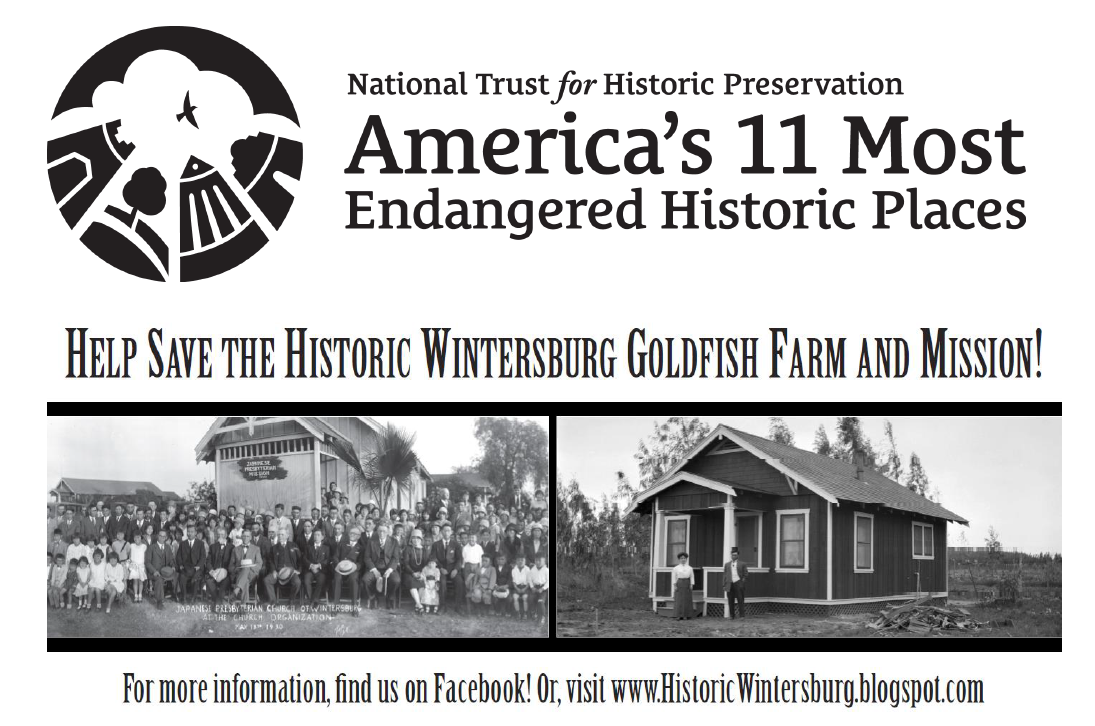
   The inclusion of Historic Wintersburg on the National Trust for Historic Preservation's "11 Most Endangered Historic Places" list is a national call to action.  In one truly remarkable property, the nation has the opportunity to save American history while investing in the rebirth of the Wintersburg Village and Oak View neighborhood.

   Why did it make the list?
  • Historic Wintersburg is a rare Japanese-owned pioneer property, predating California's Alien Land Laws of 1913 and 1920 which prohibited Japanese immigrants from owning property. In contrast with other immigrants, Japanese also were prohibited from becoming citizens.
  • Unlike other Japanese American historical properties which relate to World War II confinement, Historic Wintersburg reveals the daily life of the pioneers who settled Orange County.  The mission property--Orange County's oldest Japanese church of any denomination--was the heart of activity for the Japanese community.
  • Despite exclusion, alien land laws, World War II forced evacuation and confinement, and modern urbanization, Historic Wintersburg's goldfish farm and mission survived.  Intact.  All six structures telling the story of California pioneer history. 
  • Part of the "Japanese Mission Trail," the Wintersburg Japanese Presbyterian Mission is representative  of the migration and settlement pattern of Japanese immigrants in California following increased Pacific Rim interaction.  The Wintersburg Mission was the fifth mission established through the efforts of the national Presbyterian Church, working with a multi-faith group including Buddhists, Episcopalians, and Methodists.
  • Of the handful of noted Japanese properties documented in a 1986 survey of Orange County, the majority have been lost to demolition and development.  The evidence of a significant population of pioneers has almost been erased.

The Furuta bungalow, circa 1914.  The property was lush, planted with gum trees, and fronted the country road of Wintersburg Avenue (now Warner Avenue).  Later, a manicured hedgerow surrounded the front lawn and acres of goldfish ponds filled the farm site. (Photo, Furuta family collection) © All rights reserved.

How does preservation benefit the community?

   Historic Wintersburg is located in a neighborhood of Huntington Beach known as "Oak View," one of the city's lowest economic zones and predominantly Spanish speaking.  Like 100 years ago, the neighborhood has remained diverse.  

   Approximately 10,000 people live in the one-square mile of the former Wintersburg Village and Oak View, with an elementary school immediately adjacent to the Historic Wintersburg property.  As reported in an Orange County Register article in 2013, "the Oak View neighborhood has a higher level of poverty than much of the rest of Huntington Beach, and most residents there are Latinos. Nearly 1,000 children attend the school sites – Oak View Elementary School and Oak View Preschool – and nearly 100 teachers and staff members work at the two schools."

The Oak View Preschool and Elementary School, adjacent to the south end of the Furuta farm at Historic Wintersburg. (Photo, August 2014)

   Some of the issues facing the Oak View neighborhood are diminishing open space, access to fresh foods, access to health care in the neighborhood, job creation and training for advancement, and access to community meeting space for adult and child programs.

   Would demolition of historic features and elimination of open space for commercial / industrial use in Oak View help the neighborhood?  Or, would working with Oak View to on historic preservation combined with adaptive reuse better meet the needs of the neighborhood?

Gunjiro, Hal and Nori Tashima outside the Tashima Market, circa 1920s.  The Tashima Market was located across Wintersburg Avenue from the Wintersburg Mission, in the area of present-day Warner Avenue and Lyndon Lane.  An open field next to the market was home to the first Japanese baseball league in Orange County.  Next to the Southern Pacific Railroad tracks, at a site that now hosts an automobile repair shop, was a blacksmith.  (Photo courtesy of Eugene Tashima) © All rights reserved.

The History of Wintersburg Village, the Future of Oak View

   The modern, outside-the-box preservation approach supported by the National Trust for Historic Preservation considers the history of a property with the present-day community.  Stand alone house museums are not always sustainable and history can coexist with the modern world.  With creative historic preservation, something remarkable can happen.  Neighborhoods can be transformed.

   Imagine entering the property off Warner Avenue, greeted by a scene reminiscent of Wintersburg Village, lush and green, a water feature with goldfish and water lilies, the historic buildings open to the public.  Now add a re-creation of the Tashima Market, providing farm fresh produce and staples at the first floor, with community meeting room space on the second floor (exactly what the Tashima Market provided in the early 1900s).  A walkable market and community center for those living in the neighborhood.

Left: Raymond Furuta on a Caterpillar tractor at the Historic Wintersburg property, circa 1960.  Once highly productive, the property has never been used for anything other than a goldfish and flower farm.  During Rainbow Environmental's ownership, there has been a pumpkin patch and nopale cactus. (Photo, Furuta family collection) © All rights reserved.

   Imagine part of the property returned to farming, providing farm-to-table herbs, specialty vegetables or foods to the chefs of Huntington Beach.  The result: locally produced food, neighborhood jobs of a variety of skill sets, relationships with chefs and restaurants, and a professionally guided path into Huntington Beach's resort and hospitality industry with room to advance.  

   Imagine a neighborhood health clinic, upstairs in the Tashima Market, or as part of the 1947 ranch house (one of the six historic structures on the property).  A walkable place for parents with children and health services for the adjacent preschool and elementary school.

   Jobs, revenue, needed services, beautification, and preservation of community history.  This is just a glimpse of what can be achieved through a modern and creative approach to historic preservation and adaptive reuse.  Preservationists are committed to working with Oak View, the surrounding neighborhood, and the community to achieve a mutually beneficial vision for Historic Wintersburg.

How to help transform a neighborhood


   The Historic Wintersburg Preservation Task Force needs financial support and partnerships to acquire the property.  It's that simple.  This unique and irreplaceable history can be lost to demolition and potentially replaced with a strip mall and additional industrial use in the neighborhood.  Or, with support, we can recognize the history of Wintersburg Village while creating a new future for Oak View.

The wish list:
  • URBAN LAND INSTITUTE: Funding in the amount of $35,000 is needed for the Urban Land Institute (ULI) technical advisory program (TAP), a critical path priority.  The TAP is a two-day intensive evaluation by a team of land use, preservation, financial and development experts incorporating the input of community stakeholders---those living and working in the neighborhood, the current property owner, the adjacent school and preservationists.  The final report is a nuts-and-bolts tool with practical visions for the ultimate preservation and development of the property. 
  • OUTREACH: Funds for outreach materials and exhibits.  Historic Wintersburg has been offered many opportunities to share the history with educational materials and photography exhibits, including an upcoming exhibit at an Orange County museum.  Donations can help support this important outreach effort which can bring more support for Historic Wintersburg's preservation.
  • STABILIZATION: Funding or pro bono professional services are needed for the stabilization of historic structures.  Some immediate actions can be taken to prevent degradation of the historic structures until their ultimate restoration.  This includes removal of tree branches or other items that can place stress on the buildings.
  • PROPERTY PURCHASE: Donations of all amounts are needed to support the ultimate property purchase and restoration.  The property's current value will be part of the ULI process, however, it is known the approximately 4 1/2 acre parcel was purchased for over $4 million.  There are creative partnerships and development incentives, with the assistance and guidance of the National Trust for Historic Preservation.
WINTERSBURG VILLAGE: A glimpse of the diverse community that founded the Wintersburg Mission in 1904 and, in this photo, the Wintersburg Church in 1934.  Congregants and founders stood in front of the Church building along Wintersburg Avenue, then a dusty country road.  The roof line of the Furuta bungalow can be seen in the background.  At that time, there was room to breath in Wintersburg and Oak View. (Photo courtesy of Wintersburg Presbyterian Church) © All rights reserved.

   Help support the preservation of Historic Wintersburg, before pioneer history is lost, and, be part of the future of Oak View.

DONATION INFORMATION: Donations may be as a charitable donation per IRS code 26 U.S.C. 170(c)(1) and are used solely for the Historic Wintersburg project.  Online and mail donation information at http://www.huntingtonbeachca.gov/i_want_to/give/donation-wintersburg.cfm 

Donations to the Historic Wintersburg Preservation Fund are solely for the purpose of historic preservation for the Wintersburg project. Donations may be deductible as a charitable donation, per IRS Code, 26 U.S.C.170(c)(1). - See more at: http://www.huntingtonbeachca.gov/i_want_to/give/donation-wintersburg.cfm#sthash.R2ABVdz6.dpuf
FACEBOOK: Join supporters on the Historic Wintersburg Facebook page for more frequent news and updates at https://www.facebook.com/pages/Historic-Wintersburg-Preservation-Task-Force/433990979985360

© All rights reserved.  No part of the Historic Wintersburg blog may be reproduced or duplicated without prior written permission from the author and publisher, M. Adams Urashima.